


If you're shopping for paraffin-free candles, chances are you've landed on two favorites: soy wax and beeswax. Both are renewable, both are a step up from paraffin, and both have loyal fans.
In this guide, we'll compare soy wax vs. beeswax candles on burn time, scent, soot, sourcing, and price. We'll also share why Milkhouse, which once blended the two, now makes every candle with soy wax alone.
Soy Wax vs. Beeswax: What's the Difference?
The biggest difference is where each wax comes from.
Beeswax is made by honeybees, who produce it to build their honeycomb. Soy wax starts with soybean oil, which is processed into a soft, creamy wax. That makes soy wax plant-based and vegan, while beeswax is an animal-made product.
The similarities are just as important. Both are renewable resources. Both are biodegradable. Both are eco-friendly choices that support people close to home: local beekeepers on one side, local agriculture and soybean farmers on the other. And both are a better fit for many homes than paraffin wax, which is made from petroleum byproducts.
So, you can't really go wrong with either one. The real question is which wax is the best match for the kind of candle you want to light. Beeswax suits people who like a quiet, naturally honeyed candle that sets a mood without competing for attention, while soy suits people who like fragrance options and want their candle to command the room.
Want a soy wax candle for your home? Shop our Candle Collection.
The Benefits of Beeswax Candles

Beeswax has earned a devoted following because it's natural, renewable and paraffin-free, and it comes with a few extra perks that candle lovers appreciate.
Milkhouse knows this firsthand. We used to make our candles with a blend of soy and beeswax but have moved to an entirely soy-based wax. We'll explain why below.
First, let's give beeswax its due.
Longer Burn Time
Beeswax has a higher melting point than soy wax, which means it melts more slowly and tends to burn longer. If you want a candle that sticks around for many evenings, that's a real advantage.
The tradeoff is that a harder wax can take longer to form a full melt pool, so give it a little patience on the first few burns.
Want to get more hours out of any candle you own? Read 6 Tips to Make Your Candles Last Longer.
Clean Burn
Pure beeswax is a clean-burning wax. When it's paired with a well-sized wick, beeswax candles burn cleanly and produce minimal soot.
That's a nice contrast to paraffin candles, which are known for leaving black soot on jars, walls, and ceilings. If you've ever noticed dark smudges above a candle, you know exactly what we mean.
Air Purification
You'll often hear that 100% pure beeswax candles purify the air. The theory is that burning beeswax releases negative ions, which attach to airborne particles like dust and allergens and help neutralize pollutants, improving air quality. It's a charming idea, but the research behind it is thin, and a burning flame is still a flame.
We'd rather be straight with you: enjoy beeswax for its warm glow and soft honey scent, but don't count on it to purify the air. Fresh air and a tidy home will do far more for your air quality than any candle.
The Benefits of Soy Wax Candles

Soy wax is natural, renewable and paraffin-free, and it has plenty going for it beyond that. Here's why so many people reach for soy when they want a candle that makes the house feel like home.
Far-Reaching Scent Throw
This is where soy wax really shines.
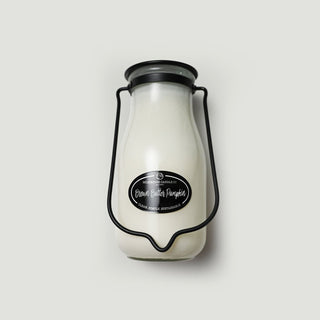
Beeswax has its own natural honey scent, which can compete with whatever fragrance is added to it. Soy wax is a softer, more neutral canvas, so it lets fragrance take center stage. That's why most scented candles you'll find, from Brown Butter Pumpkin to Oatmeal, Milk & Honey, are made with soy.
If you're wary of artificial or synthetic fragrances, beeswax's natural honey scent can be a lovely fit on its own. But if you want a candle that smells just like its name, soy wax carries added fragrances beautifully.
Clean Burn
Like beeswax, soy wax is paraffin-free and burns cleanly. It's made from a renewable plant source rather than petroleum, and with a little care (trim your wick to about a quarter inch and keep your candle out of drafts), it's a clean-burning choice you can feel good about bringing into your home.
Local Sourcing
The availability of beeswax depends on healthy bee populations and the amount of wax each hive produces, which isn't a lot.
Soy wax, on the other hand, is widely available, since it comes from crops grown on American farms. For us, that means we can source close to home and count on a steady supply.
Cost-Efficiency
Because soy wax is easier to source, it's also easier on the budget. That's something we care about at Milkhouse.
As a family-owned American manufacturer with vertically integrated production, we're able to keep our costs in check, and that helps keep our candles affordable for the people who burn them. Great fragrance for your home shouldn't feel like a splurge.
Why Milkhouse Candles Only Uses Soy Wax

In the past, Milkhouse used a blend of beeswax and soy wax. Today, we only use soy wax in our candles.
Soy has been at the heart of our story since 2002, when we became one of the original soy candle brands. Choosing soy was never just about making a better candle. It was about supporting American agriculture and the soybean farmers who help make our products possible. We're a family-owned company with Midwest roots, and every candle we produce is made in the USA.
Every Milkhouse candle is paraffin-free and clean-burning, with fragrances designed to make your home feel warm and welcoming. Whether it's a quiet evening with a good book or a table full of family, we want our candles to be part of the moments you remember.
So, Which Wax Is Better?
Beeswax and soy wax are both lovely, renewable, paraffin-free choices. Beeswax offers a longer burn and a subtle honey scent. Soy wax offers great scent throw, wide availability and a friendlier price. At Milkhouse, we chose soy because it supports American farmers and helps us make clean-burning candles that fill your home with fragrance you'll love.
Ready to find your next favorite? Explore the full Milkhouse Candle Collection and light something that feels like home.
FAQs
Do beeswax candles burn longer than soy wax candles?
Yes, usually. Beeswax has a higher melting point than soy wax, so it melts more slowly and tends to burn longer. How long any candle lasts also depends on its size, wick, and how you care for it. Trimming the wick and letting a full melt pool form on each burn help both wax types last.
Do soy wax candles burn clean?
Yes. Soy wax is paraffin-free and burns cleanly, especially when you keep the wick trimmed and the candle away from drafts. Every Milkhouse candle is made with our signature soy-based wax blend and is designed for clean-burning performance, so you can enjoy your favorite fragrance with confidence.
Are soy wax candles more expensive than beeswax candles?
No. Soy wax candles are typically more affordable than beeswax candles. Soy wax is widely available and easier to produce at scale, while beeswax supply is more limited. That's one reason soy lets us offer great fragrance at prices that work for everyday living, not just special occasions.
Do beeswax candles produce soot?
No, not much. Pure beeswax candles burn cleanly and produce minimal soot, especially compared with paraffin candles. Any candle can smoke a little if the wick is too long or the flame is sitting in a draft, so keep that wick trimmed to about a quarter inch.
Do beeswax candles smell better than soy wax candles?
No, not necessarily. Beeswax has a soft, natural honey scent that many people love, but it can overpower or compete with added fragrance. Soy wax holds fragrance well, so it's the better choice if you want a candle that smells just like its name.